REVIEW: When Books Went to War: The Stories that Helped Us Win World War II by Molly Guptill Manning

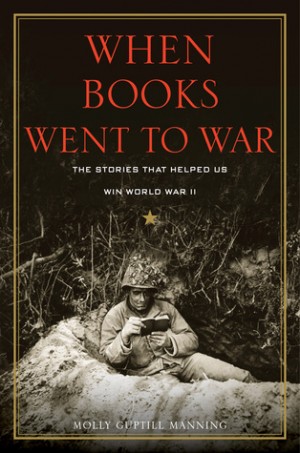
When America entered World War II in 1941, we faced an enemy that had banned and burned over 100 million books and caused fearful citizens to hide or destroy many more. Outraged librarians launched a campaign to send free books to American troops and gathered 20 million hardcover donations. In 1943, the War Department and the publishing industry stepped in with an extraordinary program: 120 million small, lightweight paperbacks, for troops to carry in their pockets and their rucksacks, in every theater of war.
Comprising 1,200 different titles of every imaginable type, these paperbacks were beloved by the troops and are still fondly remembered today. Soldiers read them while waiting to land at Normandy; in hellish trenches in the midst of battles in the Pacific; in field hospitals; and on long bombing flights. They wrote to the authors, many of whom responded to every letter. They helped rescue The Great Gatsby from obscurity. They made Betty Smith, author of A Tree Grows in Brooklyn, into a national icon. When Books Went to War is an inspiring story for history buffs and book lovers alike.
Review:
Dear Molly Guptill Manning,
Robin mentioned your book in one of her news selections one day and I was so intrigued that I decided to purchase it.
I unashamedly admit that this book made me cry more than once. Of course every book lover knows that the books are capable of delivering great comfort to us when we need it, but I never knew the extent to which books did that for American soldiers during World War Two. I know a lot about that time from family history and reading, but the war I am familiar with took place on the Eastern front. I am still learning about the war in which American soldiers participated and feel that I still have a lot to learn. This book is very detailed and seems to be an extremely well researched account of how Americans succeeded in delivering millions of books for their servicemen to read when they were waiting to fight, when they were aboard ships, when they were recovering in hospitals, and so on and so forth. The book also advances the obvious argument that while Germany burned books which the regime deemed inappropriate for Germans to read; in the US the books became part of the war of ideas and helped win the war in many ways. I am saying that this part is obvious because I am not sure who can argue that book burning is a good thing.
It was interesting and educational to learn about how books for servicemen were first collected (there was a huge book donation campaign organized by American librarians), how the Council on Books in Wartime was born, and how the printing of Armed Services Edition (ASE) paperbacks started. I found all of this fascinating and not too dry at all.
However, what impacted me the most were the letters from soldiers to the Council, telling them what the books were doing for them and what kind of books they wanted to read. These excerpts are something I am sure I will come back to reread later on.
I liked that the people who were in charge of choosing the books for soldiers tried as hard as they could to give them the books they wanted to read, even if they had to fight against censorship at home, and as a romance reader I was especially pleased to read this request:
“One such request came from a serviceman serving off the Gold Coast in West Africa. This soldier said that books such as Forever Amber, Strange Fruit, and The Three Musketeers (Tiffany Thayer’s version) were what men really wanted. “The books that are most read are the books that have at least an essence of – to put it bluntly- sex and lots of it,” he said. While his unit was lucky enough to have secured copies of Forever Amber and Strange Fruit (most likely because someone asked a relative to send them), both books were overused, with Forever Amber commanding a waiting list of at least thirty men, and Strange Fruit having one almost as long. Clearly, they needed more copies, preferably in the council’s conveniently sized ASE format. Many men echoed these title requests.”
The problem was apparently that Forever Amber and Strange Fruit were banned in Boston for indecency and some members of the Council’s editorial committee “objected to having to give their approval on a number of … books that they consider of a trashy nature”. I was pleased to learn that the end of this particular battle was good, though. Apparently the Council’s executive board tried to come down again and again on the side of printing and sending to soldiers the books they really wanted to read.
“If these books … give the boys overseas the kind of release from tension that they want, then the committee should be delighted to give their approval of the books.”
Of course the books with a lot of sex in them were not the only ones that were wildly popular amongst the servicemen. Apparently “A Tree that Grows from Brooklyn” by Betty Smith was another incredibly popular title because it reminded many soldiers of the life they left behind. I think the letters that the soldiers sent to Betty Smith could make you tear up too. I know I did, and it, inspired me to finally read the book which I have had on my Kindle for a while.
“When I first picked up your book, I was down in the dumps, a sad sack, as the boys say,” a sergeant said to Smith. But as he read, “my spirits rose until at the end I found myself chuckling over many of the amusing characters.” He needed the lift that A Tree Grows in Brooklyn had given him. He had felt depressed and lonely for months, and nothing had given him any relief from these feelings, until Smith’s book. “I haven’t laughed so heartily since my arrival over here eight months ago,” he said.”
The book argues that reading so widely during the war helped servicemen decide to take advantage of college education offered to them by G.I. Bill, which in many ways helped to form the new middle class. I have to take this argument on faith, but it made sense to me.
I am not sure how to grade this kind of book. I know I was very engaged in the narrative and moved by the subject matter. But I cannot catch mistakes in the research if they exist because I am not familiar enough with the subject.
Grade B+.
AmazonBNKoboAREBook DepositoryGoogle

Great review Sirius! I saw the author of this book interviewed on television about her research into the book’s subject matter. The program to distribute books to soldiers sounds pretty amazing and the soldier’s responses very moving.
I heard the interview on NPR and was cheered by the book sponsors efforts to get Forever Amber or whatever else they wanted to read into the soldiers’ hands.
A Tree Grows in Brooklyn was one of my favorite books when I was a teenager. I could understand how the soldiers would want to read this strong, family centered novel. It must have been a bittersweet experience for so many young men so far from home.
Thank you for sharing the review. I’ve been meaning to read When Books… and I’ll put it on my TBR list.
My father was one of those American soldiers who benefited from the efforts recounted in this book. I have vague memories of seeing at least one of the Armed Services Editions, so I was so glad to learn of this book.
I loved it! Great history of a not very well known (now) war effort. I cheered on the libraries early efforts (Victory Book Drives) to collect 10 million books (mainly for the training camp/base libraries). And then the co-operation of the major publishers to get paperback books into the hands of the men overseas. (And they even paid royalties to the authors for these editions!).
The author also covers magazine distribution, as well–another collaborative effort.
And let’s not ignore politics! The whole successful effort was nearly derailed in 1944 by partisan politics. The author does a good job of laying out the basics of that fight.
Even less well known, to me at least, was the effort to help restock the libraries in Europe that had been almost destroyed by the Nazi book purges.
Of equal interest to me was the list of all the books that were published as an ASE. Those of us who are of a certain age will certainly recognize many of the titles as staples of the local library in the 1950s. For younger readers, it offers a look at what was popular during that era. Of course,
not all the books were current releases–the publishers did go all out to cover all areas in fiction and non-fiction.
I cannot recommend this highly enough.
I grew up with a father who served in WWII and he told us that he would trade his cigarette allotment for these books. He went on to earn a Phd. at the University of Chicago attending on the GI Bill, so there may be something to the idea that reading opened up new possibilities for veterans of this war.
@Barb in Maryland: I I never heard about Title 5, but literate interpretation of it by the army amused me lots. Well done.
Politics should have never interfered with what was unquestionably good cause IMO and I was happy to read that it was thwarted.
@Janine: Thanks. This book was also reviewed in “NY Times”, so if you want to read a much better review, take a look there (I was very scared to look at it till my review was up because I knew I would start worrying about how many things I missed).
@Darlene Marshall: Thanks. And I am definitely going to try to read “A Tree grows in Brooklyn” sooner rather than later.
After it was mentioned by Robin, I started looking into this book. After reading your review, I pulled the trigger and bought the book. Can’t wait to read it.
Thanks so much for this review–I need to find this book! And A Tree Grows in Brooklyn is one of my all-time favorite books. I can even say I grew up with it. When I was young, the first part of the book, when the heroine Frannie is also young, was my favorite. Then as I grew older, the latter half of the book, where Frannie is a young woman, spoke to me. Sigh. Time for a reread.
@Mary Beth: Thank you for sharing your father’s story!
Jayne, ML I hope you guys will enjoy the book.