REVIEW: How to Survive History by Cody Cassidy

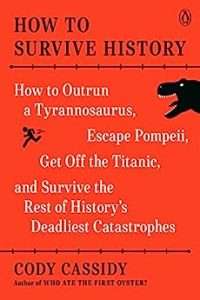
A detailed guide to surviving history’s most challenging threats, from outrunning dinosaurs to making it off the Titanic alive
History is the most dangerous place on earth. From dinosaurs the size of locomotives to meteors big enough to sterilize the planet, from famines to pandemics, from tornadoes to the Chicxulub asteroid, the odds of human survival are slim but not zero—at least, not if you know where to go and what to do.
In each chapter of How to Survive History, Cody Cassidy explores how to survive one of history’s greatest threats: getting eaten by dinosaurs, being destroyed by the asteroid that wiped out the dinosaurs, succumbing to the lava flows of Pompeii, being devoured by the Donner Party, drowning during the sinking of the Titanic, falling prey to the Black Death, and more. Using hindsight and modern science to estimate everything from how fast you’d need to run to outpace a T. rex to the advantages of different body types in surviving the Donner Party tragedy, Cassidy gives you a detailed battle plan for survival, helping you learn about the era at the same time.
History may be the most dangerous place on earth, but that doesn’t mean you can’t visit. You can, and you should. And with a copy of How to Survive History in your back pocket, you just might make it out alive.
Review
I had so much fun reading Cassidy’s second book, “Who Ate the First Oyster,” that when I saw this one I immediately requested an arc to read. (Thanks Raven for hooking me up!) The book focuses on a series of specific past catastrophes and assumes a few things such as you have access to a time machine to be transported to them and that, among a few other things, by following Cassidy’s sometimes very specific directions, you won’t be hit by falling debris as no one can predict where this will land. But with his research into the events, into the cityscapes/landscapes/ships, etc where the events occurred, and by keeping your cool, you just actually might be able to keep far enough from a T-Rex’s car-crunching sized jaws to make it out alive.
So can you outpace one of the worst predators in our planet’s history? Yes. Maybe. Given the estimated speed of an adult and if you’re in reasonable shape and you utilize the evasion tactics that allow (slower) impalas and zebras to dodge (faster) cheetahs and lions. However if you catch the eye of a juvenile T-Rex, your odds just plummeted. Do you want to see how you’d fare during an ice age mammoth hunt? Make friends (as one spear will only make the animal mad), learn to use a spear thrower, and face it head on. How about a lovely day in Pompeii on August 24th, 79CE? Don’t stick around after the initial eruption and either make for a boat in the bay or head north but do that quickly as you’ve got to make the 15 miles to Naples by early afternoon.
Surviving the ten year gloom that plunges most of northern Europe into famine due to three horrific volcanic explosions beginning in 536 is more challenging but doable. If you’re in the exact right place and have some food and supplies, you might even live through Chicxulub and that’s saying something. Make it out of your steerage room and onto a lifeboat as the Titanic goes down? Here are the directions and a map plus instructions about how to abandon ship (if you don’t initially get onto a lifeboat). How about the San Francisco 1906 earthquake or the (frankly terrifying sounding) Tri-State tornado of 1925? Only if you move fast and know where to go – and where not to go. Oh, and don’t look like a looter in SF.
Cassidy adds little history lessons, scientific explanations, and some fun to each chapter. One of the first things Gutenberg printed was an appeal to Christian Europe to head to the aid of Constantinople in 1453. The city fell but Cassidy gives you two options to escape. What was the death knell to the golden age of piracy in the Caribbean? Sugar cultivation and the need to protect the ships bearing enslaved Africans to work there from pirates. If you were an Egyptian during the building of the Great Pyramids, you’d get fed for free but have to “donate” four months of your life to the project. But hey, the work crews gave themselves nicknames and engaged in trash talking. Who is the first person known to circumnavigate the Earth? An enslaved Filipino native.
I had a blast reading this and – one day – I will get back to reading the first book. The chapters are short enough to snack on when you don’t have a large amount of time or you can (as I did) settle down and gorge yourself on the entire book in one day. The choice is yours but I do recommend it. B+
~Jayne
AmazonBNKoboBook DepositoryGoogle

This sounds both fun and educational. Thanks for bringing it to my attention, Jayne!
@Kareni: It is and you’re welcome! If you like it, check out his other books, too. There is a bibliography at the end of the book and he names names of experts he consulted.
Thank you for the review! I’m thinking of getting this for family reading time with my 12 and 9 year olds. Is it appropriate for kids (aside from the overarching theme of death and escaping it)?
@Julie: I would think so except for maybe the Donner Party during which Cassidy discusses cannibalism.
Thank you so much for your insight, Jayne! Our library hold arrived yesterday so I think we may start tonight!
@Julie: You might also want to check out “Who Ate the First Oyster” in which Cassidy explores what might have driven technological innovations in human history.
https://dearauthor.com/book-reviews/overall-b-reviews/b-plus-reviews/review-who-ate-the-first-oyster-the-extraordinary-people-behind-the-greatest-firsts-in-history-by-cody-cassidy/