Review: A Trade of Blood: An Ana and Din Mystery (Shadow of Leviathan Book 3) by Robert Jackson Bennett

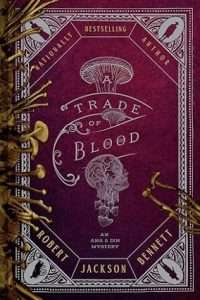
Detective Ana Dolabra must prove a condemned man’s innocence and confront a terrifying magical technology in this fantasy-mystery from the bestselling author of The Tainted Cup, winner of the Hugo and World Fantasy awards.
The heir to one of the Empire’s most powerful families sits in jail, accused of murder. His hands are covered in the victim’s blood, and he can neither deny his guilt nor explain his actions.
But if the great detective Ana Dolabra cannot save him from the noose, the farming canton of Sapirdad will explode into war, threatening to plunge the whole Empire into starvation and chaos.
As Ana investigates—her assistant Dinios Kol, as ever, acting as her eyes and ears—she fears her task is even more daunting than it seemed. For this murder is just the latest in a deeper, subtler web of death, woven by a mastermind with an ancient weapon at his disposal.
With their customary skill, Ana and Din pursue their adversary through the canton’s wild ranges, sprawling ranches, and reeking slaughterhouses. Yet even they are not prepared to learn the horrifying secret behind their opponent’s powers.
Review:
Dear Robert Jackson Bennett,
I reviewed the first two books in these series here at DA. I was bound to read the third one anyway, but two of the book clubs I belong to are reading it, so I did it sooner rather than later. It was a very engrossing book, but I also suspect that my time with this series may be coming to a close. I mentioned even when I reviewed the second book that I started to roll my eyes at the editorials discussed as afterwords. I actually would love to ask the author what other ways of feeding the society he may suggest if farming is so evil? That does not mean that I disagree that there are too many products becoming genetically changed. I know there are problems with our food, trust me, but I like to actually eat food and as flawed as farming became I cannot imagine any other ways of actually obtaining that food. But I digress. Believe me though my rant is connected to the story, because as much as the afterword is about our world, the whole story’s message seemed to me that the ways the Empire produces food are very VERY gross.
And they are gross, the way they slaughter cows, the way little cats pick out the plants, oh my god and when you read what was done to these poor little cats to make sure they pick the plants and other grown foods, eh I wanted to kill the people who came up with that myself. It is just too bad I like to eat and not just plants, I like to eat meat, so I was the very wrong audience for this book.
You will ask me – but what about Ana and Din? Do they investigate anything in this book? Of course they do, and it is a well written investigation. The murders were very gross too, by design, and totally made sense. I mean, I wrote above that the message of the story is that the way the Empire produces the food is very gross, but also more and more the message seems to be that the Empire is rotten inside and out and nothing can save it.
I really liked the way the investigation was written – Ana figuring out pretty fast what was the murder weapon, but trying to find out who did it and going step by step. I was actually amused at some GR reviews, because I did not feel as if everything important was just revealed at the end, I felt as if the writer fed us the information throughout the story and you could at least nail the possible killer to a couple of people.
I loved how Din matures with every book, but still has his own anxieties which made perfect sense – as an engraver he does not have a very long life span and unless the briefly mentioned medication will make an appearance, he will go mad in two or three decades. Do I want to read such an ending for poor Din? Absolutely not. Can I trust this writer that this won’t happen based on his past books? Not at all. I am still convinced that Ana is toasted at the end, but especially after this book I feel as if they both could be dead at the end of the series simply because if the Empire will be destroyed, as augmented products of those experiments, they can die with it.
Hopefully I am wrong. Oh, and I really liked Din’s sister.
Grade: B (because it really was very well written, even if I fully expected seeing some very deformed bodies in my dreams after I was done)
AmazonBNKoboBook DepositoryGoogle

I was under the impression this is the last book in the series, primarily because the author has written trilogies or standalone novels. Hopefully I’m wrong, although things seem more dire for Anna. I also felt the author’s censure/argument about food, specifically flesh, and have been thinking about that a great deal. As you said, he’s not wrong and we have to do better … although I don’t think you’re the wrong audience. You don’t avoid books that challenge or inform you.
I enjoyed this book as much as the other two; the crimes become more complicated and Din’s skills and confidence grow. The clues are everywhere and it’s up to us to see them. Din’s sister is terrific and, if there are future books, I hope we learn more about that family (good or bad). And about the origin of the Leviathans. I’d also like for Din to be happy. Too much to ask?
Thanks for your review.
@Darlynne and @Sirius: My husband and I are currently 20% of the way in to this book and so far I’m loving it. I may change my mind when things get more gross, as I have the feeling they are about to. I will look forward to Din’s sister but please no more spoilers about her or the rest of his family, at least not without spoiler warnings.
With regard to the farming, I didn’t read the afterword to the previous book; I’ll see if I can check it out again to do that. I am vegan so I doubt this will bother me at all but I wanted to say that I can think of plenty of ways to eat animal products that are more compassionate and less harmful to the environment than the current factory farming system we have in the US now.
There are genuinely free range animals who are fed their natural foods (previously herbivorous farm animals were even fed meat, and that was how we got mad cow disease), though you have to research it to find them. Yes it’s more expensive but if more people bought their meat, it would get less so with economies of scale.
Personally I think factory farms are horrific. I started to detail some of the harrowing things that are done to animals (and no, I don’t mean killing them, I’m referring to the things that are done to them before that). It would not be hard to reform the system partially, we just don’t do that. As a country we don’t care that much about animal welfare if the animals aren’t pet animals.
Hunting (for those who can do it) or buying meat from hunters is also more compassionate (these animals get to live in the wild rather than spend their entire lives penned up, ill and tortured), though it has its risks. Another option that may work for some people is to just eat a little less meat, not none.
I’m not trying to rail at you for eating meat, but please don’t say that nothing can be done. It’s not true.
W/r/t Ana and Din’s eventual fate, I’m sorry to hear that. I try not to dwell on it so I can enjoy each book as I read it but it’s very possible that the bill for that enjoyment will come due at some point.
@Janine: I didn’t say that nothing could be done. I said ( or at least what I was trying to say ) that I felt that in the afterword author said that farming is bad without offering any solutions how to change it . Honestly if nothing was changed in the book and afterword was cut – I would liked it much better. Author’s unhappiness about farming to me came off clear enough in the book and I had no issues with the book . To be blunt first and foremost afterword felt like preaching to me and this is a second book in a row when I felt the same way about his afterwords so if I will read next book I will just skip it most likely .
@Sirius: Ugh. I did have other issues with the book, but not how this theme was executed.
@Darlynne: I believe it was originally planned to be a trilogy but not anymore. See, I think mystery was well done and investigated, but to me it was way too easy to zero in on the villain even if I picked the wrong one out of my two candidates. I do agree that Din’s skills are growing and someone at my book club said that maybe if Ana dies ( it is not a spoiler, but my speculation that I cannot abandon) he will take over as main investigator? Oh I would love for him to be happy. At first I hoped for the guy from the first book to come back, but now I have no idea considering how events unfold here ( no spoilers).
@Darlynne The author did an AMA on Reddit a while back (after the second book was published maybe?) in which he said 3 books were contracted but he would like to write more, with installments a la Miss Marple mysteries.
Correction to my comment above: the AMA was after the second book was written but only the first had been published.
https://www.reddit.com/r/Fantasy/comments/1alwymm/im_fantasy_author_robert_jackson_bennett_ama/
@Jmc: Thanks. I definitely would like to see more.
@Janine: I don’t *think* I said nothing can be done and I agree with everything you wrote about factory farming, etc. And I didn’t realize Din’s relative was a spoiler. My apologies.
@Sirius: Ah, I see. I apologize for misunderstanding. I do agree with you that it’s better for authors not to preach. I also think that stories are more powerful when they are not explained, though sometimes I enjoy an explanation. Skipping them is probably a good choice.
@jmc: Actually there was a more recent post where he said he’d like to write a seven-book series, so I’m guessing he changed his mind about writing Ana and Din books for as long as they sell. I forget where I saw it; it may have been another Reddit AMA with him but I’m not sure.
@Darlynne: The farming part was a response to Sirius’s review, not to your comment. Yes, for me the fact that Din’s sister was in the book was a spoiler, because I’ve been eagerly waiting to see if Din would ever be reunited with his family. But I can see how it’s not a spoiler for many people, and actually I’ve reached that part and it happens around 20% or 25% in, which is early in the book in my view. So I would not count it as a spoiler if I were writing a review.
(My rule of thumb as a reviewer was to not mention anything that happens after the first third, but earlier events are often good to relay so that the readers will know what conflict(s) the book revolves around.)
So I don’t think you or Sirius did anything wrong (I’m just very spoiler sensitive). If anyone owes anyone an apology, it’s me.
@Sirius: Our of curiosity (and not to criticize), do you think it would be better if RJB offered solutions for how to change farming in the afterword? It seems like that might be even more annoying to readers because it would be (or could seem) prescriptive.
@Janine I don’t know . I try not to imagine what would have been better or worse with the story if something was not written/ written differently. However sometimes I can’t help myself of course. So I do think that the story would have been stronger without author jumping in and started talking directly to the reader about contemporary times . It is no surprise that I consider first book the strongest one and I do not believe it had an author’s note. Second book I felt as if author decided to write a lecture about autocracies are bad . So again to be blunt maybe even crude . The only response I had was eye roll and saying Duh . The story itself showed to me why autocracies are bad . Here the same thing – story itself showed pretty gross farming practices . Author deciding to tell the reader that farming is bad to me was preachy and unnecessary and I would have felt the same way if I didn’t eat meat. Having said that if I encountered this as a separate essay from the author yeah I would have liked that.
I don’t know why my response is in a different color sorry.
@Sirius: It was a broken link. I fixed it.
@Janine: Great thank you very much.
My review that I wrote on the arc in goodreads. I had the same knee jerk dislike of the afterward as Sirius:
This was another masterfully written book, with marvelously creative world-building and believable, sympathetic characters whether hero or villain. The mystery at the heart of the book features a murder set in a Romeo and Juliet/feuding family conflict. Bennett writes this like an old skool mystery, which I love, and you can solve it yourself if you pay attention to the sprinkled hints throughout. I guessed the “who” and their motivations fairly early in the book, but this did not diminish my enjoyment of the subsequent reveals. And the “how” was way twistier than I initially imaged (I do love a good story inspired by the strange things found in nature, truth is stranger than fiction and all that).
I also enjoyed the further development of and reveals about the main characters and the overarching mysteries of the world. We learn more about both main characters. We meet some of Din’s family and there’s a big secret shared about Ana at the end of the book. I’ve noticed with each subsequent book in this series, we are marching inexorably closer to the inner rings and the enigmatic imperial sanctum.
I did find Bennett’s “lessons” about the warped agricultural practices that serve as a backdrop for this story a little preachy. While I very much agree with him and his opinions, the author’s note at the end of this book (and the last one) felt like a sledgehammer to the head. It’s like those Planet Earth documentaries when they tell you at the end that everything beautiful you’ve just been appreciating on screen is crumbling and dying due to human destruction as we speak. I’m all for authors using their platforms to do good and maybe we as a species really do need the sledgehammer to the head, I don’t know.
@Sirius: Yeah, I hear you. I hate preachiness too, even for a cause I subscribe to. You’ve made me curious to read this afterword, and at the same time i wonder if I wouldn’t be better off skipping it! I’m still not even halfway through, and so far I’m enjoying the book.
@Janine: And you may not find it preachy in the first place. I thi k you said you skipped afterword to the second book ? If so – maybe go back and see if you find it preachy or not ? Because while topic of the afterword was different – for me it was same
Effect. So it could be good enough prediction to see if you should read the one in this book or not when you get to it .
@Li: thank you for posting your review ! I wonder what we will find in the Sanctium ( probably more ugliness but some surprise would be good too :)). I keep forgetting to say that yes I very much hope for more Din’s family secrets in the later books.
I finished! This turned out to be my favorite book in the series thus far. My husband and I read it together and he felt the same way. I liked Din’s arc, the way he came to see the empire differently than he had before. I really liked the side characters of Fotia and Tauri (even with everything that happened) a lot, too, and I hope we see more of them. The ending points to more of Din’s family, so that will be interesting as well. Even Ana was more appealing in this book than in the earlier ones, IMO.
Incidentally, did the revelations about Ana at the end of the book surprise anyone here? I’ve been thinking this about her since the last book at least.
I also thought it was interesting that where earlier on, Ana felt that her job and Din’s was, in its messy and flawed way, noble or at least worthwhile, by the end of the book it seemed like she felt differently. I don’t think this was a continuity error, I think it’s evolution, and I’m curious about where Ana and Din will be in the next book in regard to that.
With regard to bad things happening to the characters in the future, yes, it’s very possible. But I try not to think about it when I read because I enjoy the books more if I don’t. The foreshadowing about Din’s mental health worried me, and like Din, I didn’t expect those issues to begin so soon.
Overall, A Trade of Blood left me eager for the next book in the series. I really want to see more of Din’s family. I’m curious, too, about the significance of Din’s mother’s presence in his memories.
With regard to the afterword, I waited a few days after finishing the book to read it so it wouldn’t affect my reading experience too much, and then I skimmed it. It didn’t bother me but it might have if I had read it right after finishing the book. My husband (also vegan) liked and appreciated it. However, I don’t think for the author to say what should be done to make farming less cruel and damaging would have been appropriate. I’m actually glad he didn’t. It would have made the afterword that much more didactic.