REVIEW: Bring the House Down by Charlotte Runcie

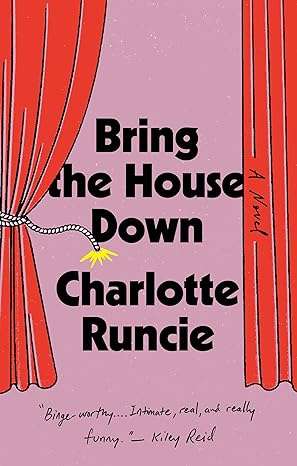
Alex Lyons always has his mind made up by the time the curtain comes down at a performance—the show either deserves a five-star rave or a one-star pan. Anything in between is meaningless. On the opening night of the Edinburgh Festival Fringe, he doesn’t deliberate over the rating for Hayley Sinclair’s show, nor does he hesitate when the opportunity presents itself to have a one-night stand with the struggling actress.
Unaware that she’s gone home with the theater critic who’s just written a career-ending review of her, Hayley wakes up at his apartment to see his scathing one-star critique in print on the kitchen table, and she’s not sure which humiliation offends her the most. So she revamps her show into a viral sensation critiquing Alex Lyons himself—entitled son of a famous actress, serial philanderer, and by all accounts a terrible man. Yet Alex remains unapologetic. As his reputation goes up in flames, he insists on telling his unvarnished version of events to his colleague, Sophie. Through her eyes, we see that the deeper she gets pulled into his downfall, the more conflicted she becomes. After all, there are always two sides to every story.
A brilliant Trojan horse of a book about art, power, misogyny, and female rage, Bring the House Down is a searing, insightful, and often hilarious debut that captures the blurred line between reality and performance.
CW/TW – death of a parent, adultery, mention of past ghosting and philandering
Dear Ms. Runcie,
I was hesitant to try this book given the blurb which mentions some pretty awful things. And yes, all these things happen. Who tells us about it all is not either Alex or Hayley but Sophie, a fellow newspaper critic who witnesses it while living inside the same flat with Alex in Edinburgh.
I’ve seen feminist and female rage attached to descriptions of the book. That is here. But there’s a lot more to the book than that. Sophie is struggling with writing reviews of the events that she’s assigned and wonders who she is writing for – the performers/artists or the readers and attendees. Alex has told her what’s behind his (usual) one star (scathing) reviews. Sophie often finds herself trying to be polite in hers. Which is better and for whom?
“Fair criticism doesn’t exist,” he’d said to me in the newsroom once. “Life isn’t fair, so why should I be?”
Of course the story dips into both Alex’s and Sophie’s private lives and of course their lives influence how they approach their jobs. Alex’s mother is a leading lady in the UK, a “national treasure,” but growing up in a mercurial household of actors who are insecure and emotionally needy wasn’t easy and an experience he had as a teenager shaped how he views writing nicey nice reviews vs being brutally honest to those who need to hear that. Sophie has had to scrap to earn her place at the newspaper and was reminded at the beginning (by Alex) that she was only a newbie and had to earn respect.
What Alex does to Hayley is terrible and is a choice he made. He could have avoided the whole thing by being honest with her about who he is and what he’d written but he wasn’t and didn’t. When Hayley does exactly what Alex tells Sophie he wants his criticism to do – make the artist learn and do better – Hayley grabs the upper hand and turns the white hot spotlight of men’s actions against women on Alex. Suddenly Sophie is learning all about some awful to atrocious things that Alex has done. She’s also conflicted. Is she supposed to take a side and which side should she take – Alex’s as a fellow critic in the same workplace or that of women who have been done wrong by both Alex and men in general?
As his past gets publicized in Hayley’s shows, Alex tosses information about these events to Sophie and tries to rationalize what he did – until a few things come to light that even he admits were wrong. With his professional and personal life circling the drain, Sophie has a front row seat. But Sophie and her partner also have issues to work out as it’s clear that their communication needs work and one did something painful to the other in the past. We also see that even though Hayley is riding the comet of public acclaim, it’s taking a toll on her.
“Haven’t you ever done something you regret? Why am I the only one who has to learn something here?”
I like that all the characters are nuanced and have made mistakes. No one is perfect in life or in the book. Alex says something truthful when he tells Sophie that no one wants all their faults hauled out for public inspection. What doesn’t work so well for me is that despite this being hailed as a book of feminist rage and smashing the patriarchy, most of the book revolves around Alex who we see much more of than we do Hayley. We hear of Hayley and get told what she’s doing but after her first searing revenge show (and I will admit this is a great scene), she’s actually not in the book much.
Sadly most of Sophie’s time is also spent focusing on Alex when she’s not thinking of her faltering personal relationship and how much she misses her toddler son. Frankly, she comes across as mostly bland except for a middle section in which she struggles with reviewing vs criticizing and where to land with what she writes. Sophie ought to have been examining why she’s so angry and frustrated with her partner Josh who, like many men, acts as if doing half of what a woman does and for only a few weeks should earn him sainthood.
By the end of the book, I’m not sure what everyone has learned. Alex makes a public statement in a very public venue but then goes back to work at the paper albeit in a different role. Sophie and Josh … work things out? I’m still not sure but they seem to still be together. Sophie has figured out a few things about what kind of work she wants to do and makes a move towards that. Hayley just sort of drifts off into the sunset which is disappointing. The events and people in the story are a bit depressing and not quite the feminist raging I was promised but there are issues raised that do make me think. B-/C+
~Jayne
AmazonBNKoboBook DepositoryGoogle
