REVIEW: Feral Machines by Ginn Hale

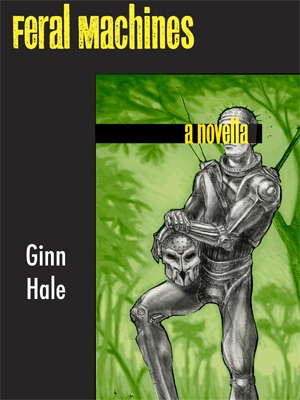
When the interstellar wildlife sanctuary Casaverde is quarantined due to an mysterious outbreak of malaria, Andrew Salazar must turn to military surplus synthetic life-forms to help him in his work as warden.
But Andrew soon discovers that the synthetics are far more complex creatures than he first imagined and that something more deadly than an old-world disease is stalking Casaverde.
Review:
Dear Ginn Hale,
Recently I attempted to read an m/m romance in which a man falls in love with robot. I disliked it very much, and then I remembered that once upon a time you wrote a novella which was part a “Tangle” anthology done by Blind Eye Books (several years later the novella was published separately as an ebook). Janine reviewed the complete anthology here at DA in 2008, and I also liked most of the stories, but I really only want to talk about your story because it is an example of how a man and robot (way too simple of a description for who Thomas is, but I cannot go into more details without revealing significant spoilers) falling in love can be done really well.
Andrew has been living on Casaverde as one of the two remaining volunteers for several years. Casaverde is a unique planet because it was set up as a wild life sanctuary, where wild life forms which had been extinct on Earth and other planets actually manage to thrive. It is a fragile and beautiful place, but also a very dangerous one. Unfortunately, the good intentions of the people in charge do not last long after they learn how many useful minerals Casaverde has. They introduce malaria bacteria to the planet, which cause most of the volunteers to get sick (not die but as we know malaria is no joke and people need to be treated) and require evacuation. Andrew is sick too, but he refuses to call for help, because in order for Casaverde to become a self-governed colony (as the story begins he has less than two years before it will happen), it has to be continuously inhabited by no less than two people.
The second human “volunteer” is Rannon, who in my opinion needs help even more than Andrew because he suffered a psychotic breakdown years ago (psychotic breakdown are the words from the book) and he is not in good shape. But Andrew refuses to call for help for Rannon because then he would be ordered to evacuate from Casaverde, the Department of Development would start to develop Casaverde as it sees fit, and of course the wildlife habitat wouldn’t survive.
I have to admit that as much as I liked the developing romance between Andrew and Thomas (one of the “synthetics” Andrew buys and whose life story I want to conceal in case you decide to read the book), I found the ethical dilemma that Andrew faces in his dealings with Rannon the most memorable conflict of the story. In fact, this is what I remembered about this book for years after I read it.
Do the ends justify the means? Does your desire to save the wildlife on a planet justifies keeping a mentally ill person a prisoner on that planet, one he came to hate and which stripped almost all humanity away from him? I thought it was a clever set up that Casaverde had no other people left except Andrew and Rannon, so the stakes are wildlife vs. one person, not the lives of many vs. the life of one. I will be honest, I really hated Andrew when I read the story as part of the anthology and then reread it in 2011 when it was published separately as an ebook, because I could not relate to his choices at all. For me, his fanatical insistence on saving animals and plants vs. letting Rannon get into such an awful condition was very unsettling. And I am often very unhappy with how we treat Earth, so it is not like I do not get where Andrew is coming from.
I did like the book overall, though, and it stood up to a reread well. I am thinking that making the reader ponder over ethical dilemmas may have been author’s purpose. I also have to admit that during this reread I liked Andrew a little more – I still cannot fully relate to his choices about Rannon, but seeing how desperate he was and how hard he tried, I decided to cut him some slack.
Andrew’s relationship with Thomas and with two other synthetics was fun to watch. I liked that the author seemed to put a lot of thought as to who synthetics were and how they were created. I liked that the romance with Thomas felt very slow burn, and despite this novella not being too long, it did not feel like an Insta!Love of any kind. I actually thought that they may have had a future together.
Grade B.
AmazonBNKoboAREBook DepositoryGoogle

I think I liked this better than you did; I’d give it a B+ at least, because I just love love love Ginn Hale’s prose. IMHO, she also captures subtle emotional nuance and slow burn romance better than any other m/m I can think of. And despite the overall seriousness of the story, there were enough lighthearted and even silly bits of humor that kept me from getting depressed while reading it.
But you’re right about Andrew’s ethical dilemma, and I just want to mention (in the context of Jennie’s review of LAST NIGHT IN MONTREAL) that this is clearly a case of a story with a strong sense of moral clarity, even if it is left (intentionally, I think) ambiguous as to whether the characters made the right choices.
I love her prose too and I think B is a very good grade :). Agree about moral clarity and ethical dilemmas.
I gave this a B+ when I reviewed it here but in hindsight I agree with your grade of B. Ginn Hale does write beautifully (though I found her language more appealing in her early works, like this novella and Wicked Gentlemen, than in Lord of the White Hell or The Rifter) but what bothered me about the story was that there wasn’t much anger from Thomas or the smaller robots toward their former owner after they were freed. Yes they were freed, yes, Andrew was a relatively “benevolent” master, but they were still enslaved. Shouldn’t there be *some* antagonism or trauma there, even if it’s veiled?
I had totally forgotten about Rannon, until reading this review. But as you’ve laid it out here, I can understand and believe in Andrew’s dilemma. It’s not the same thing, but I’ve hung out with people who are very committed to animal rights, and after spending years rescuing animals that have been mistreated by humans, some of them would save an animal over a human, if it came down to it. I’m not saying it’s right, just that that kind of misanthropy can sometimes set in when someone is very devoted to a cause.
@Janine: I always love her language – “Champion of Scarlet Wolf” was pretty much my best m/m read last year. You know, it is interesting, I went and reread your review and this did not bother me at all, because for some reason I did not think of it as slavery and I don’t know why. I mean, it sure was, but in my head it did not register – maybe because I first thought of them as machines and never completely let it go and I do not see owning machines as slavery? I am not sure I can articulate why, but what I know for sure is that I was not bothered. Oh it is not that I do not understand the choice. It is not a matter of right or wrong to me, it is a matter of not being able to relate you know?
And as I said in my review I worry a lot about how we (we as in humanity as a whole) mistreat our planet, I find the attitude of not thinking about what we will leave to our kids and grandkids and great grandkids ( again talking about humanity in general) to be a disgusting one. I think we abused Earth for way too long and often think that all the natural disasters is Nature’s way of giving us the last warnings before it gets too angry and swallows us all :(. So it is not like I do not understand people who want to preserve Nature, I do too. What I cannot relate to is taking it to the next level as a story so cleverly did – if I will ever be in the life threatening situation and if I would be brave enough which I have no way of knowing if I actually will, if all those conditions come true, I know that given the choice, I will save a person. They are “my people” after all, if that makes sense. Every other species I want to thrive, but not at the expect of such sacrifice Andrew was ready to make. I was easier on Andrew this time mostly because I forgot that he was sick with malaria almost all the time during the story, I choose to believe that he was not in the entirely rational state of mind when he did not call for help for Rannon till it was almost too late.
As I recall they were part human, or at least Thomas was, right? And I think Andrew felt he should free them, that that was the right thing to do, but he was afraid of what would happen to Casaverde without their labor. I saw that as the principal ethical conflict at the center of the novella, and I saw the Rannon subplot as being there partly to highlight the fact that Andrew (in his state of mind at the time; I think you’re absolutely right that the malaria affected his reasoning–that’s how I read it too) could cross moral lines for Casaverde.
As for whether owning machines is slavery, that’s a philosophical question some SF works have explored. I think at some hypothetical point, if machines become sophisticated enough to feel as well as think, at our level or even at a higher level, then it will be something close to slavery. Of course, it’s debatable.
I would put a human life ahead of a refuge like Casaverde too, but if I were in Andrew’s shoes and had invested so much of myself in it, it would be a painful sacrifice. In real life of course it’s not a choice between nature and a human life, because human lives and livelihood depend on our ability to preserve our environment — and we still can’t get our act together.
With regard to Hale’s language, I think Wicked Gentlemen had a somewhat different style, with more vivid imagery, though part of that was the way the worldbuilding played into it. It’s my favorite of her works. I couldn’t get into Lord of the White Hell at all. I liked the beginning of The Rifter, despite the somewhat altered writing style, but partway through (I think it was in part four of the serial) she lost me with too much suffering and monotony in the tower. It was a pacing issue as much as anything. I would like to give her another shot at some point, though.
And that’s a great point about this not being a choice likely to happen in real life actually. Thanks Janine :). I would prefer not to discuss in details who Thomas was because I feel it is a bit of a spoiler :), but I did not get the impression that other two were human. I may have misunderstood. In any event what I was trying to say that no matter what I did not think of it as slavery – thinking of them as machines may have been a reason why, or not. I just know that I did not think of it as main ethical conflict of the story – interesting how differently two people can interpret same story yes?
This one sounds intruiguing. I have wishlisted and will wait for a special. I have a constitutional dislike of paying $4 for a book which is less than 100 pages (aka I’m cheap).
@Sirius: Good point about the spoiler. I was fuzzy about the details of the others and couldn’t recall if they were purely robots or not. And to clarify, I didn’t think of slavery per se as the main conflict, but rather of Andrew’s conflict re. freeing them as the main conflict. I think there was an external conflict too but I don’t recall it nearly as well as the internal one. Sorry for the fuzziness; I only read this novella once, seven years ago. And yes, different interpretations of the same story are always interesting.