REVIEW: The Creatures’ Guide to Caring by Elizabeth Preston

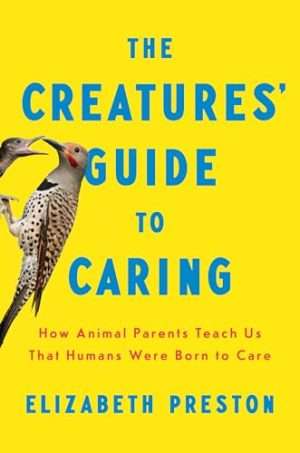
A lively and revelatory journey through the evolution of caretaking on Earth, from animal parents to modern-day humans, making the case that caring for children and one another made us who we are
Poison frog fathers carry tadpoles on their backs. Killer whale grandmothers hunt to feed their adult sons. Tropical birds incubate their friends’ eggs. Spider moms let their hatchlings eat them alive. Around the world, animals from the exotic to the familiar go to astonishing lengths to keep their young alive. Their biology, brains and behaviors show us what we have in common with other creatures, as well as what’s unique about Homo sapiens.
With warmth, humor, and occasional run-ins with bodily fluids, science journalist Elizabeth Preston leads a highly accessible tour of cutting-edge research into how and why we and other animals care for young. She discovers that humans evolved to raise our kids in cooperative groups, and that the tools we’ve inherited for caretaking aren’t only for moms or parents in general—they’re the basis for our human society.
Review
In her bio, Preston is described as “a science journalist who contributes regularly to” various newspapers, magazines, and online media. I think this accounts for the definite readability of this book. It’s easy to sink into, entertaining, and packed with cool facts from the scientists Preston interviews. As an armchair reader who has trudged through NF books with fascinating topics but which ended up being told dryly, I appreciated that it kept me wanting to read. But …
After a while I noticed that Preston would talk about whatever animal the scientist to whom she was speaking studies, and then she’d draw her conclusions. Running these past the interviewee would sometimes get a chuckle and a “possibly, maybe.” Sometimes they’d gently correct her or, as one scientist said, “I’m quite cautious about drawing too many direct parallels.”
I finished the book having learned a lot about various species that ranged from bees and wasps, shrimp, crabs, fish, snakes, mongooses, monkeys, various birds, naked rats, and voles (the popcorn of the prairie) among others. But I ended up still not completely convinced that we can “draw these parallels.” As Preston winds up the book even she admits that there is really no way to peer deeply back into our human past and be sure how we evolved. Still, I don’t regret reading about these amazing scientists and the fascinating work they’re doing and the information about these animals and humans that we’re discovering. B-
~Jayne
AmazonBNKoboBook DepositoryGoogle

Leave a Reply