REVIEW: Cold Peace: A Novel of the Berlin Airlift, Part I (Bridge to Tomorrow Book 1) by Helena P. Schrader

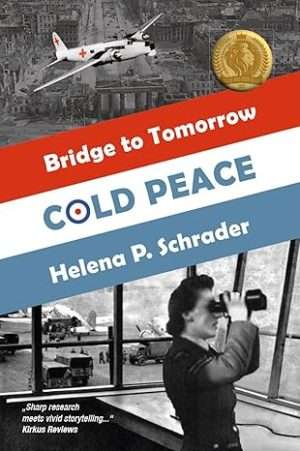
The economy is broken, the currency worthless, and the Russian bear is hungry.
In the ruins of Hitler’s capital, war heroes and resilient women struggle in the post-war doldrums — until they discover new purpose in defending Berlin’s freedom from Soviet tyranny. When a Russian fighter brings down a British passenger plane, the world teeters on the brink of World War Three. The first battle of the Cold War is about to begin.Based on historical events, award-winning novelist Helena P. Schrader brings to life the backstory of the West’s bloodless victory against Russian aggression via the Berlin Airlift in Cold Peace, the first book in the Bridge to Tomorrow Series.
Dear Ms. Schrader,
I just happened upon this series and as I’m currently fascinated with Berlin, I decided to give it a whirl. “Cold Peace” definitely took me back to those vast, sprawling historicals of old with a huge cast of characters that takes about 100 pages to totally introduce readers to. There are a lot of moving pieces and times when the narrative would finally loop back to a bit that hadn’t been on page for a while and I’d have to stop for a second to recalibrate who this character was but once it got going, I was hooked.
From reading the blurbs, I knew to start this one before “Cold War” but I didn’t realize that so many of the characters were first introduced in other books and novellas. It would have been easier to learn all these people, I think, had I read those books first but once I had some background info, I was fine.
The action is sprawling but mainly centers around RAF Gatow outside Berlin with its new Wing Commander and his wife who arrive thinking they’re going to a backwater as well as a place that Robin Priestman isn’t enthusiastic about. Most British people who were in the military have … mixed feelings about Germans and Germany. Which is fair enough as the Germans have mixed feelings back. The French are, so far in the story, snooty bit players while the Americans are simultaneously envied for their seeming wealth and not having had to endure rations as well as seen as loudmouths, show-offs, and ready to shoot first before asking questions. I do wish that there wasn’t quite so much national stereotyping.
Most of the action focuses on the British and the Berliners. Once they arrive in Germany, most of the British are astonished at the level of destruction and gobsmacked at the way the Berliners are having to live. The Germans are resentful of how the Western Allies didn’t try to protect them from the predations of the Soviets once they, the Allies, arrived in Berlin and skeptical of how long the British, Americans, and French will stay given that Berlin is a bombed out wreck filled with former enemies. And that’s before the Soviets finally pull the plug on even pretending to work with the other three occupying powers. Once all access is cut off, will the Western Allies stick it out, or leave Berlin to the “mercy” of the Soviets?
As I said, this one lumbers a bit to reach the take off point on the runway before finally lifting off. There is a lot of detail given about many of the characters (and remember it mainly focuses on the British in this book) that humanizes them but also slows the action down. The dialogue is also clunky at times. I am glad to see several German characters as well who presented various viewpoints from born and bred Berliners to refugees from the country who arrived in time to endure what the Soviets put the citizens through. Some are tougher than others. There is a subplot about a German-Canadian Jewish former pilot who, along with his best friend, a New Zealander (of course nicknamed “Kiwi”), who is trying to start an air ambulance service as well as follow up on family property in Berlin that was stolen from his murdered relatives.
Given the complex politics and tense relations between the occupying powers, there is a lot of ground to cover and lay out. Some of the action switches back to the UK to include characters who I am assuming will be more pivotal in the coming book as well as the background personalization moments mentioned above some of which, honestly, weren’t needed. Since the book ends with the airlift just being decided on and not yet fully underway, “Cold War” is more character rather than action centered. Yes, it’s a bit slow going at first but now that I’m fully involved, I’m looking forward to the next installment. B-
~Jayne
AmazonBNKoboBook DepositoryGoogle
